
If you own a property in Mallorca, cypresses are probably one of the first trees you’ve considered. They’re everywhere on the island — lining finca entrances, forming tall privacy screens, framing pools and terraces. And for good reason: few trees combine elegance, low maintenance and resilience to the Mediterranean climate as well as a cypress does.
But not all cypresses are the same, and choosing the wrong variety for your space is a common and costly mistake. This guide covers the four varieties available through our store in Mallorca, what each one is best suited for, and how to choose based on your garden’s specific needs.
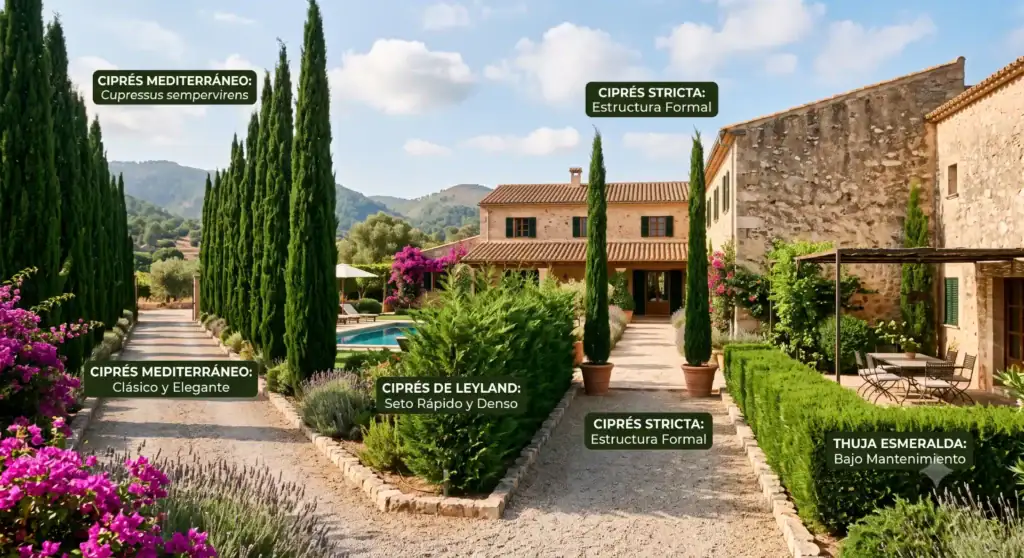
The Mediterranean Cypress (Cupressus sempervirens): the classic choice
The Cupressus sempervirens is what most people picture when they think of a cypress — tall, narrow, dark green, unmistakably Mediterranean. It’s the cypress you see lining the roads of traditional Mallorcan fincas, and it fits perfectly into both classic and contemporary garden designs.
What it’s best for: formal alignments along driveways, tall privacy screens, and as a focal point in large gardens. Its naturally columnar shape means it needs very little pruning — it will hold its form on its own.
What to consider: it grows slowly compared to Leyland, so if you need privacy quickly, this isn’t your fastest option. But it lives for hundreds of years and gets more impressive with age. Available from 40/60 cm starter plants — ideal if you’re planting a long row and want to keep costs down — up to large 3.5/4 m specimens for immediate impact.
Leyland Cypress (Cupressus × leylandii): fastest growing privacy screen
The Leyland is the go-to choice when speed matters. It can grow up to 60–90 cm per year under good conditions, making it by far the fastest way to create a tall, dense hedge in Mallorca. It’s widely used in urbanisations, villas and anywhere a quick visual barrier is needed.
What it’s best for: fast privacy screens, boundary hedges and noise barriers. If you need to block a neighbour’s view or shield a terrace from the road within two or three seasons, Leyland is the answer.
What to consider: because it grows fast, it also needs more frequent trimming to stay tidy — typically once or twice a year. It also reaches considerable height if left unchecked, so it’s not the right choice for small gardens or spaces with height restrictions. Available in two sizes: 60/80 cm and 170/190 cm.
Cypress Stricta: elegant structure for formal gardens
The Cypress Stricta (Cupressus sempervirens ‘Stricta’) maintains a very precise, pencil-thin silhouette throughout its life — more controlled and architecturally refined than the standard sempervirens. It’s the choice when the shape itself is part of the design.
What it’s best for: formal garden designs, symmetrical planting pairs at entrances, and situations where you need a very controlled vertical accent without regular pruning. It also works beautifully in large pots for terraces and courtyards. Available at 180/200 cm — ready to make an immediate statement.
What to consider: slower growing than Leyland but far more architectural. If aesthetics matter more than speed, this is the right choice.
Thuja Esmeralda: the low-maintenance hedge alternative
Thuja is technically not a cypress, but it serves the same purpose in many gardens and is consistently chosen alongside them. Its soft, pyramidal foliage is slightly warmer in texture than cypress, and it responds exceptionally well to trimming — which makes it one of the most popular hedging plants for residential gardens in Mallorca.
What it’s best for: neat, trimmed hedges, garden boundaries, and screening in residential gardens. It’s also more tolerant of partial shade than most conifers, which makes it useful in spots that don’t get full sun all day. Currently available at 50/70 cm — ideal for planting a new hedge from scratch.
What to consider: it grows at a medium pace — faster than Mediterranean cypress, slower than Leyland. It doesn’t reach the dramatic heights of the other varieties, which is actually an advantage if you want a hedge that’s easy to manage long-term.
Which cypress should you choose? A quick comparison
| Mediterranean Cypress | Leyland Cypress | Cypress Stricta | Thuja Esmeralda | |
|---|---|---|---|---|
Price | from 2,38 € | from 6,40 € | 54,40 € | 16,15 € |
Available sizes | 40/60 · 100/125 · 300/350 cm · 3,5/4 m | 60/80 · 170/190 cm | 180/200 cm | 50/70 cm |
Velocidad de crecimiento | Slow | Very fast | Slow | Medium |
Best use | Formal alignments, long-term | Fast privacy screen | Architectural accent | Neat trimmed hedge |
Pruning needed | Minimal | Regular (1–2x year) | Minimal | Occasional |
Wind resistance | Excellent | Very good | Excellent | Good |
Types of cypress trees: a quick overview
If you searched for “types of cypress trees” or “cypress varieties for gardens”, here’s the short version:
Cypresses are broadly classified by growth habit and origin. In Mediterranean gardens like those in Mallorca, the four most-used varieties are: Mediterranean cypress (columnar, classic), Leyland (fast-growing, dense), Stricta (slender, architectural) and Thuja (neat, trimmed hedge). All four are available through our store with island-wide delivery.
Less common in Mallorca are varieties like Arizona cypress (Cupressus arizonica, blue-grey foliage) or creeping juniper (Juniperus horizontalis), which are less suited to the Balearic climate and less used in Mediterranean landscaping projects.
For privacy hedges in Mallorca, Leyland wins on speed and Mediterranean cypress wins on longevity.
How to buy cypresses in Mallorca
All four varieties are available through our online store with delivery across the island. We stock everything from small starter plants — ideal for planting a long row at lower cost — to large specimen trees for immediate visual impact.
If you’re not sure which variety or size is right for your project, we’re happy to advise. Most of our cypress orders come from homeowners planning a hedge or entrance planting, and a quick conversation can save a lot of time and money.