
Carritx (Ampelodesmos mauritanicus) is a hardy, perennial Mediterranean grass adapted to conditions of high sunlight and low water availability. Although it tolerates drought, proper irrigation is key to maintaining its erect structure, vigor, green color, and ability to regrow.
This article delves into how to water a carritx according to its biology, the type of substrate, the climate, the season, sun exposure and whether it is planted in a pot or in the ground, answering all the questions that users usually look for.
Carritx physiology applied to irrigation (key to understanding when to irrigate)
Carritx is a C3 grass highly adapted to poor soils and intense sun exposure. This means:
Deep, fibrous roots
Root systems can explore the soil to a good depth, reducing their dependence on surface irrigation.
Adaptation to wet-dry cycles
Its physiology favors alternating periods of moderate humidity with partial drying of the substrate. Excess water inhibits root respiration.
High evapotranspiration in summer
Its long, linear leaves increase water loss in dry climates, so the frequency of watering should be increased in summer.
In conclusion, Carritx does not tolerate permanently wet soils, but neither does it tolerate prolonged water stress. Irrigation should promote deep moisture and moderate drying.
How does the type of soil or substrate influence the irrigation of carritx
Irrigation varies radically depending on the type of soil:
Carritx in a pot
The pot dries much faster, especially in sunny areas.
- Small pots → quick drying → more watering
- Large pots → more water retention → less watering
- Container material:
- Mud → evaporates more → more irrigation
- Plastic → retains moisture → less watering
Recommended potting substrate:
- 50% aerated universal substrate
- 25% washed river sand
25% perlite / volcanic gravel
This ensures drainage + moderate retention.
Carritx on the floor
On land, irrigation depends on natural drainage:
Sandy soils: need more frequent watering
Silty soils: ideal balance
Clay soils: avoid, they retain water and cause rot.
General rule: the more aerated the soil, the more frequent the watering should be.
Ideal watering frequency according to season, climate and exposure
Here is the technical guide:
Water Carritx in spring
Frequency: 1 time per week
- The plant begins active growth, evapotranspiration is moderate.
Water Carritx in summer
Frequency: 1–2 times per week
- If there is dry wind: increase to 2.
- If it’s in a pot in direct sunlight: check every 3–4 days.
Water Carritx in autumn
Frequency: Once a week or every 10 days
- Lower water demand due to reduced photoperiod.
Water Carritx in winter
Frequency: 2 times a month
- Low metabolism + risk of anoxia (lack of oxygen) in roots.
How to tell if your Carritx needs water
Don’t rely solely on the calendar: evaluate the substrate.
Method 1: finger or toothpick
Insert 3–4 cm into the substrate:
- Dry → water
- Slightly damp → wait 1–2 days
- Wet → do not water
Method 2: Foliage observation
- Brittle leaves = lack of water
- Yellow leaves at the base = excess water
- Dry new shoots = very intense sun + insufficient watering
How to water a carritx step by step
1. Soak the root zone, not just the surface
You’ll see that the water takes 2-4 seconds to seep in: that’s a good sign.
2. Slow watering
Use a watering can with a fine spout or a manual drip system.
Avoid strong jets that could erode the soil.
3. Allow to drain completely
If the substrate remains waterlogged for more than 2 hours, the drainage is inadequate.
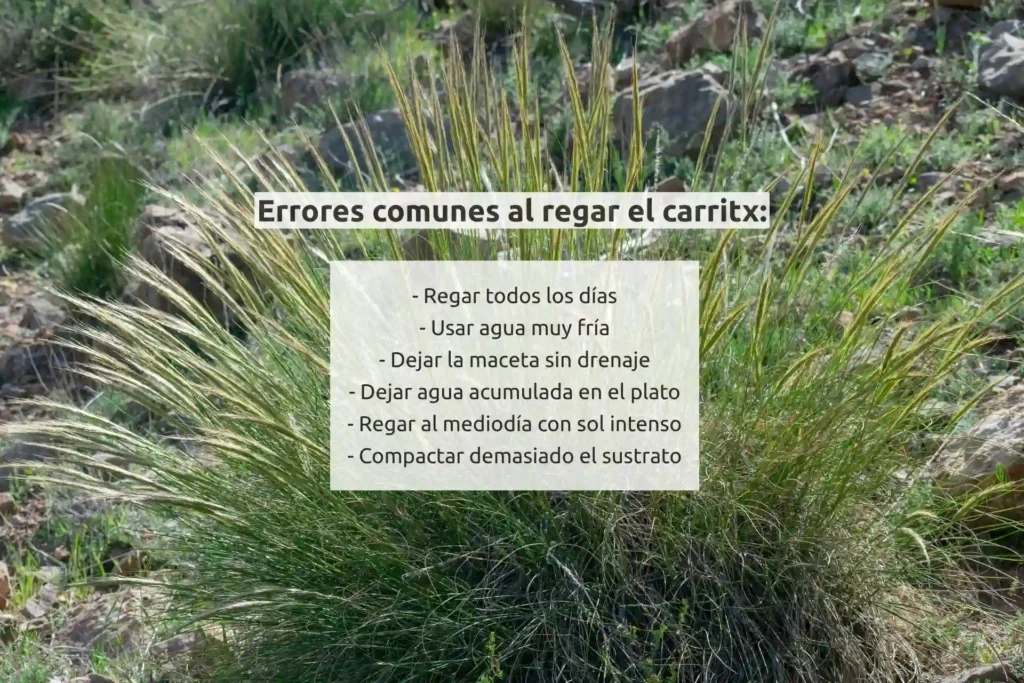
4. Avoid watering in direct sunlight
Watering in full sun can cause a “magnifying glass effect” and extreme evaporation.
5. Adequate water
- Filtered or left to rest for 24 hours
Temperature: 18–22°C
Watering newly planted or transplanted carritx
After the transplant:
Days 1–7
- Maintain constant humidity (not wet)
- Water moderately every 2–3 days
Days 7–20
- Reduce to every 4–6 days
After the 20th
- Return to normal schedule
Justification: During the first few weeks, the plant has not reactivated its deep root system.
Symptoms of excess or insufficient irrigation of the Carritx
Overwatering (very common in pots)
- Yellow basal leaves
- Soft stem at the base
- Soil with a fermented smell
- Propagation of white mold
Lack of irrigation (more common in summer)
- Dry leaves from the tip
- Slight curling of the foliage
- Straw color
- Growth stalled
Get your Carritx in Mallorca
Get your carritx now in our online store and receive it at home ready to plant.